
The surge in applications, the scarcity of qualified profiles, and the growing demand for speed from clients are reshaping the value chain of recruitment agencies. Artificial intelligence provides processing and analytical capabilities that would otherwise be impossible to achieve.
Executive summary
The recruitment industry is undergoing a pivotal shift. An average of 183 applications per job and 43-day hiring cycles (Sept 2024 Hiring Pulse, Workable) put continuous pressure on consultants.
In this environment, artificial intelligence is no longer optional - it is becoming a decisive competitive advantage.
AI solutions enable recruitment firms to:
- Reduce Candidate Acquisition Cost (CAC) by saving recruiter time and optimizing spend (less manual work, lower external sourcing costs)
- Increase Candidate Lifetime Value (CLTV) through personalized engagement and improved candidate experience - maximizing the long-term revenue a candidate can generate across multiple placements
- Improve Customer Retention Rate (CRR) thanks to higher shortlist quality and shorter time-to-hire
Adopting AI today - solutions that augment recruiters, integrate seamlessly with existing systems, and process hundreds of millions of profiles - allows firms to:
- Protect margins in a volatile, competitive market
- Boost productivity by automating time-consuming tasks
- Prepare for the future, before AI becomes a universal market standard
Recruitment firms that act quickly will lead the era of augmented recruiting, while others risk being left behind.
Preface
Time spent on hiring is time well spent
Robert Half (1914 - 2001), founder of Robert Half International
“While Robert Half’s quote remains timeless, the surge in job supply and candidate demand calls for a necessary update. Today, it is no longer enough to hire well, companies must hire fast and well to remain competitive.
Recruitment firms face growing challenges: increasing hiring needs, exploding volumes of candidate data, and the need to preserve healthy margins. AI transforms traditional practices by helping consultants manage mass data and detect opportunities that would previously have been invisible to the human eye.”
Mouhidine Seiv, HrFlow.ai Founder
About HrFlow.ai
Founded in 2016, HrFlow.ai is now a global technology leader in artificial intelligence applied to human resources and talent management.
The company supports large employers as well as HR tech providers. Its clients include reference players such as ManpowerGroup, Kelly Services, Fed Group, Crit, Sanofi, Safran and Monster.
As of 2024, HrFlow.ai processes more than 100 million resumes worldwide, in 43 languages, including 20 million in France, representing almost the entire active national workforce.
Principal HR Market Analyst, a graduate of HEC Paris and former strategy consultant at BCG, the author Maxime Colombet combines analytical expertise and field experience to decipher the transformations taking place within the recruitment sector. This white paper aims to provide strategic insight into the adoption of AI and its impact on the value chain of recruitment firms.
Introduction - Recruitment Firms: Pillars of a Specialized Economy
1. Market Overview and Major Players
Recruitment agencies are HR specialists that provide end-to-end hiring services. Their consultants oversee the entire recruitment process across all job categories. While these firms primarily focus on permanent positions, they have also expanded their offerings to include temporary staffing and executive search.
Their business is structured around three main components:
- Sourcing opportunities: Identifying clients’ hiring needs.
- Sourcing candidate profiles: Building and maintaining a strong talent pool.
- Selection and placement: Choosing and placing the most suitable candidates.
Benchmark of recruiting firms - HrFlow.ai 12/31/2023
The benchmark above was conducted on publicly listed recruitment firms based on the following indicators:
- Permanent placements: permanent contracts or equivalent long-term contracts
- Number of employees within the company
- Revenue from permanent placements (portion of revenue generated through permanent hiring services)
- Total revenue across all business activities of the company
2. History of Recruitment Agencies
Born out of the Industrial Revolution, recruitment firms evolved alongside changes in the labor economy to meet growing needs and support market expansion. Their development can be divided into three major phases:
- Emergence: In the 19th century, recruitment firms appeared to meet the increasing demand for specialized skills in a rapidly expanding industrial economy, and to manage the growth of the labor pool in a context of strong immigration and rapid urbanization.
- Establishment: Throughout the 19th and 20th centuries, they established themselves as essential players, helping companies recruit despite challenging conditions marked by:
- High employee turnover
- Increased specialization of labor
- Growth: In the second half of the 20th century and the beginning of the 21st century, rapid urbanization, technological advances, and economic evolution drove rising demand for specialized profiles, leading recruitment firms into sustained growth and service diversification. A notable fact: nine of the ten largest recruitment and staffing groups were founded after 1950.
3. Value Proposition and Business Model
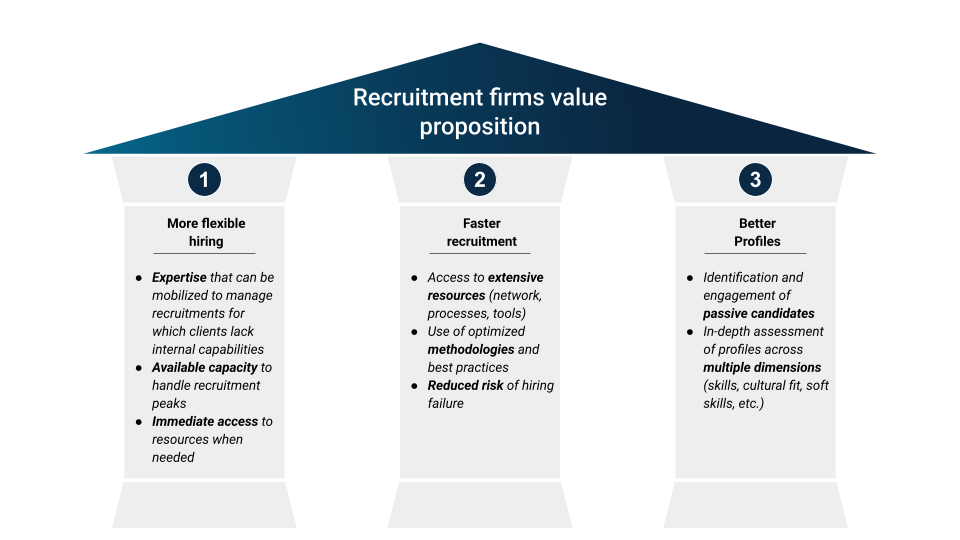
Today, the value proposition of recruitment firms relies on three main pillars:
- Flexible expertise: Recruitment firms enable HR teams to adjust capacity according to real needs (activity peaks, temporary access to niche skills), ensuring successful hiring with the certainty that the company’s requirements will be properly addressed.
- Faster hiring: Thanks to their extensive resources (network, processes, and tools) recruitment firms can identify and present relevant profiles more quickly than most internal teams, reducing vacancy duration and mitigating its impact on business performance.
- Better profiles: Through proven assessment methods and precise candidate selection, recruitment firms minimize hiring risks and help companies secure top talent by reaching more profiles and conducting thorough evaluations.
In addition, there is a secondary but strategic advantage: recruitment firms can act as intermediaries and ensure reinforced confidentiality for sensitive hiring needs, preventing any visible signals of organizational changes or disruption among existing teams.
These pillars directly structure the economic model of recruitment firms: the value they create justifies the fees they charge.
The pricing models used in the industry reflect this value proposition and vary depending on the nature of the service provided:
Drawing on their long-standing experience, recruitment firms have always adapted to labor market changes to maintain their competitive advantage and the relevance of their services. However, shifts in the employment landscape and technological advancements have begun to disrupt this balance, suggesting that client organizations may eventually catch up.
A telling illustration of this turning point comes from financial markets: all major publicly listed recruitment firms - Robert Half, PageGroup, Hays, and Robert Walters - have seen a decline in their stock market valuation compared to 2018. This downward trend signals a broader structural tension. Despite their scale, global footprint, and operational maturity, these firms now face intensified pressure on pricing, margins, and delivery efficiency. The rise of digital hiring platforms, the growing expectations around speed and transparency, and the emergence of AI-powered matching tools are reshaping how organizations evaluate the value of traditional recruitment services.
In this context, the industry appears to be entering a new phase, where longstanding models are being challenged and where the ability to leverage technology - not only to scale operations, but to redefine value - will determine which players remain competitive in the years ahead.
Recruiting Firms: Pioneers in HR Technology Adoption
1. Technological Advances and Recruitment Firms
Over the past decades, recruitment firms have had to adapt to major technological innovations. In the 1990s, ATS (Applicant Tracking Systems) and job boards emerged, profoundly transforming recruitment practices.
ATS solutions helped reduce costs and accelerate the recruitment process through keyword-based search capabilities within talent pools. They also gradually eliminated the need for storage and archiving of résumés. By adopting ATS tools early, recruitment firms were able to absorb the surge in data volumes and protect their margins when their clients began using these systems as well.
Job boards also disrupted market dynamics. Thanks to strong network effects, they attract large volumes of candidates, helping reduce CAC for their users.
Today, end-company clients have fully integrated these tools into their HR operations, enabling them to reduce costs and exert stronger competitive pressure on agencies.
In a sector highly sensitive to economic fluctuations, controlling internal costs is essential. The most resilient firms are those able to leverage technological advancements to ensure operational excellence.
While recruitment technologies might appear to threaten staffing agencies — by allowing employers to accelerate hiring and access larger talent pools independently — historical evidence shows that recruitment firms have consistently been the fastest to adopt new technologies, whereas in-house teams have traditionally lagged behind.
2. A More Efficient Market Thanks to Recruitment Firms
As mentioned in the previous section, the most successful recruitment firms have been able to leverage technological innovations to recruit faster and at lower cost than their clients, enabling them to capture additional market share. The same applies to labor market shifts, which continue to strengthen the role of recruitment agencies:
Talent shortage
First, traditional recruiters face a severe shortage of qualified talent and increasing difficulty in identifying candidates within their existing talent pools. For instance, 90% of recruiters struggle to find candidates with the required skills and experience (Zippia, 20+ Essential Hiring Statistics [2023]: Everything You Need To Know About Hiring). This challenge is amplified by the fact that many potential candidates are passive job seekers (only 30% are actively looking, according to the study Top 100 hiring statistics 2022).
Employer brand as a decisive factor for candidates
Companies may turn to recruitment firms when their employer brand is not strong enough to attract qualified candidates on its own. 75% of candidates say they evaluate a company’s employer brand before applying (Why & How People Change Jobs, 2015, CareerAct). A recruitment firm can compensate for a weak employer brand by proactively engaging targeted candidates with a structured and compelling pitch about the opportunity, and, when applicable, by leveraging its own strong reputation and ability to deliver a superior candidate experience.
Slower in-house recruitment processes
Inefficiencies in internal recruitment also create new challenges, while firms have long relied on operational excellence as their key selling point. With a median of 43 days to fill a vacancy (Sept 2024 Hiring Pulse, Workable), internal hiring drives higher recruitment costs and increases the risk of losing qualified candidates along the way.
Geographic expansion of recruitment
One of the major modern evolutions reshaping recruitment is the expansion of geographical boundaries: offshore talent sourcing has become increasingly common thanks to remote work practices — accelerated by the COVID crisis and a growing desire among workers for flexibility.Traditional recruiters may be at a disadvantage when facing broader, international audiences: language barriers, limited knowledge of foreign labor markets, difficulty gaining visibility in new regions, etc. For example, according to a Stanford economist cited by the Wall Street Journal in 2023, 10% to 20% of support roles (such as software developers or accountants) could be relocated outside the United States.
These factors highlight the significant challenges faced by recruiters, underscoring the relevance, and even the necessity, of external support from recruitment consultants.
3. A System Reaching Its Limits
While recruitment firms have historically maintained a competitive edge by outperforming in-house hiring teams, the traditional model is now facing challenges that even the firms’ expertise alone can no longer fully address. Recruiters and staffing agencies are entering a situation that is increasingly difficult, if not impossible, to manage without transformation:
- Exponential increase in candidate volume: Online platforms and easier access to information have caused a sharp rise in the number of applications per role. Each job now attracts an average of 183 candidates (Sept 2024 Hiring Pulse, Workable. This flood of résumés makes manual screening extremely time-consuming and often ineffective)
- Rising expectations from both clients and candidates: Clients increasingly demand top-quality shortlists, the primary value they expect from recruitment firms. Requirements also extend to fairness and inclusivity, where ethics and regulation require equal consideration for each application (Art. 22 RGPD & Art. L1132-1 French Labour Law).
- Human limitations in consultant capacity: screening and evaluating CVs remain some of the most time-intensive tasks. With current tools, recruiters are overwhelmed by application volumes, with no viable human substitute to keep up.
- Finally, Pressure to maintain current margins: Recruitment firms face constant pressure to protect profitability. They must optimize processes and improve efficiency amid: intensifying competition, higher client expectations, and a volatile labor market leading to pressure on fixed costs when the market is weak and difficulties in meeting demand during periods of strong growth.
These challenges highlight a systemic problem that current human resources can no longer adequately address. With the market undergoing profound change, the adoption and appropriate integration of technological innovations, and more specifically artificial intelligence, is no longer simply an option but an essential lever. For recruitment firms, this is a strategic necessity to maintain their competitiveness, optimize their processes, and preserve their position in the face of the potential rise of internal recruiters in large companies and meet the expectations of candidates.
AI offers solutions for sorting applications, identifying unconscious biases, improving the candidate experience, and predicting performance, allowing recruiters to focus on the truly human and strategic aspects of their job.
Applying AI to Recruitment Firms’ Processes
Artificial intelligence has become an essential response to the challenges of modern recruiting, as it enhances overall consultant efficiency. By applying AI across the entire recruitment process, significant value is generated for both recruiters and candidates.
Recruiter-Focused Processes
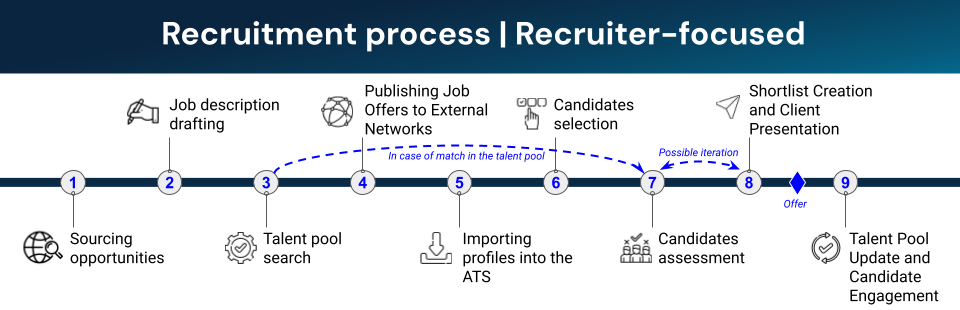
- Sourcing Opportunities
The context:
The first step in the recruitment process, the consultant proceeds to source business opportunities by identifying the recruitment needs of clients or prospects via phoning, mailing, client sites, social networks, job boards, trade shows, or advertising. The consultant spends considerable time manually identifying new assignments by multiplying actions.
However, this fragmented approach limits their responsiveness and ability to quickly spot the needs of clients and prospects, and therefore to respond to them.
The solution:
AI automates prospecting by continuously scanning market job postings (client sites, job boards, networks) and linking them to the existing talent pool. The consultant can thus prioritize the most relevant opportunities and approach clients with targeted and personalized proposals. It can also aggregate and structure the needs expressed by a client (for example, recruiting a complete team) into as many exploitable opportunities in the ATS.
Use the following connectors and APIs for extraction: Profile Parsing, Text Parsing.
To prioritize offers: Profile Searching, Job Searching, Profile Scoring, and Job Scoring.
- Job description drafting
The context:
The second step in the process, receiving the client brief and drafting the job offer, is critical for determining the client's real needs and identifying the right profiles. In many cases, client briefs are often partial, imprecise, or filled with jargon. The consultant must then rephrase, benchmark, and draft a clear and attractive offer, while respecting the firm's standards, a long and high value-added exercise, but a source of errors and inconsistencies.
The solution:
A text generation interface (LLM type) automatically synthesizes, completes, reformulates, popularizes, and even translates a job offer based on a client brief. In the absence of a brief, the content of an ideal candidate's CV can also be used to draft a suitable job offer. These interfaces then allow for attracting more qualified candidates while saving time for recruiters.
Use the connectors (to retrieve job data) as well as the following APIs: Text Parsing and Job Asking.
- Talent pool search
The context:
The third step in the recruitment process is when the consultant checks if existing profiles in the talent pool already match the defined needs. However, this manual search is often tedious and inaccurate. Many relevant candidates are overlooked, and transferable skills go unnoticed.
The solution:
AI analyzes the entire talent pool to identify profiles that match the new job opening, even partially. It predicts the possible career paths of each profile and ranks them by relevance, transforming the pool into a dynamic source of readily available talent.
When a job offer is difficult or impossible to write, AI also allows profiles to be ranked by similarity to an ideal profile. There is then no longer a need for a job offer, but simply a CV.
Use the following connectors and APIs for data extraction: Profile Parsing, Text Parsing.
For profile filtering, the following APIs: Profile Searching, Job Searching, Profile Scoring, Job Scoring, and/or Grading.
Note: The Profile Matching API may also be useful.
- External network diffusion
The context:
In cases where the search for existing profiles yields no results, the recruitment consultant is then led to diffuse the offer on various external recruitment networks (career site, job boards, dedicated sites, CV databases, etc.). This diffusion step is critical because it allows both to find the right candidate for the dedicated offer and also to enrich the talent pool to potentially respond to other future offers. However, publishing offers on several platforms remains time-consuming and poorly optimized: manual multi-diffusion, managing paid campaigns, and performance tracking mobilize a lot of time without guarantee of results.
The solution:
AI centralizes diffusion from the ATS, automates publication on relevant job boards, and adjusts campaigns in real-time according to results. The sponsoring of offers can be stopped automatically as soon as a sufficient number of qualified profiles is reached, thereby optimizing diffusion costs, moving from a quantitative metric to a logic based partly on qualitative results. Finally, AI can increase the attractiveness of offers by generating illustrative images, allowing candidates to better visualize the position.
Use the following connectors and APIs for data extraction: Text Parsing, Profile Parsing.
For profile filtering, use the following APIs: Profile Searching, Job Searching, Profile Scoring, Job Scoring, and/or Grading.
- Importing profiles into the ATS
The Context:
During the sourcing process, résumés can come from various sources (job boards, LinkedIn, career fairs, unsolicited email applications, career sites, etc.). The challenge is to consolidate these profiles into a single ATS and populate the company's custom fields. This low-value-added human task is tedious and prone to errors, complicating and slowing down the entire process.
The Solution:
AI can read a résumé and extract the information to automatically create a profile in the ATS. Once the profiles are automatically imported and enriched, the recruiter has a consistent, up-to-date, and instantly usable database.
Use the following connectors and APIs for data extraction: Profile Parsing and Text Tagging.
- Candidates Selection
The context:
Once profiles have been collected (internally or externally), the recruiter is then required to select and evaluate the different candidates. A critical step in the process, it is about ensuring that the best candidates are identified and retained. At this stage, the consultant faces a dual constraint:
- a high volume of applications (approx. 200 CVs) and/or a large talent pool to analyze
- and the necessity of a fine qualitative evaluation to retain only the best.
In reality, the recruiter spends hours sorting the CVs received, often to the detriment of an in-depth study of CVs, their soft skills, or potential cultural fit. Selection criteria also vary from one recruiter to another, introducing heterogeneity in decisions and a risk of unconscious bias.
The solution:
Artificial intelligence automates selection of profiles in a consistent manner (based on information from CVs, interviews, and tests) and then ranks them by relevance to the job offer concerned. The advanced analysis of AI then makes it possible to detect implicit talents or transferable skills often overlooked. The entire process becomes smoother and traceable, allowing the recruiter to save considerable time while improving the quality and coherence of their selections.
Use the following connectors and APIs for data extraction: Text Parsing, Profile Parsing.
For profile filtering, use the following APIs: Profile Searching, Job Searching, Profile Scoring, Job Scoring, and/or Grading.
- Candidates assessment
The context:
When a recruiter selects candidates, they must evaluate profiles to identify the most suitable one. The consultant then conducts several selection stages, including interviews, online tests, and other evaluations. It is their responsibility to precisely manage the recruitment process, conduct interviews, and analyze test results to produce a summary.
The solution:
AI supports the consultant in identifying the elements to evaluate and delve into for each candidate. It automatically generates evaluation grids and proposes personalized questions. Furthermore, AI synthesizes the reports from the different interviews and facilitates candidate selection.
Use the following connectors and APIs for data extraction: Text Parsing, Profile Parsing.
For profile filtering, use the following APIs: Profile Searching, Job Searching, Profile Scoring, Job Scoring, and/or Grading.
For question generation, use the following APIs: Upskilling, Profile Asking.
- Shortlist creation and client presentation
The Context:
Once evaluations of all candidates have been made through several interviews and tests, the recruitment consultant is led to draw up a shortlist that they will share with their client. Manually assembling standardized skills files for each candidate is time-consuming and lacks standardization. The risk is to introduce bias or to present profiles unevenly, which harms the firm's credibility. Also, the manual sharing of candidate files with the client takes time and increases the risk of errors or delays.
The Solution:
AI automatically generates the skills files from the data collected during the process. It produces standardized, complete, and visually coherent summaries, allowing the consultant to present clear and comparable shortlists. It can also generate a brief text summarizing the qualities of each selected profile. Exchanges between the client and the firm can be synchronized directly via CRM connectors, allowing for transparent follow-up and better responsiveness.
Use the following connectors and APIs for data extraction: Text Parsing, Profile Parsing.
For filtering, the following APIs: Profile Searching, Job Searching, Profile Scoring, Job Scoring, and/or Grading.
To generate text presenting qualities, the following API: Upskilling.
The presentation of the shortlist calls for a potential exchange of several profiles between the recruitment consultant and the end client to lead to a job offer.
- Talent pool update and candidate engagement
The context:
The final stage of the process involves the consultant managing their talent pool and keeping in touch with candidates, depending on their availability. Once recruitment is finalized, updating candidate data and post-recruitment follow-up are rarely systematic (sending refusal messages, personalized feedback, renewed contact, etc.). Profiles become obsolete, data expires, and the pool loses value.
The solution:
AI automates the enrichment and updating of the talent pool: it automatically informs all unsuccessful candidates with personalized feedback, detects inactive profiles, updates CVs from external sources, and personalizes follow-up messages. Retention and deletion processes are automated to ensure GDPR and AI Act compliance. The consultant can also push training suggested by the algorithm to improve the profile and further increase loyalty.
Use the connectors and APIs: Profile Parsing (profile updating), Profile Scoring (suggesting new offers), Profile Upskilling and Profile Asking (suggesting training and personalized feedback)
In conclusion, every step of the recruiting process can be augmented by artificial intelligence by automating repetitive tasks and with a high degree of personalization. Depending on the chosen use cases, the AI modules developed by HrFlow.ai make these different scenarios operational to augment the recruitment consultant.
Candidate-Centric Recruitment Process
While AI enhances every stage of the recruitment process for recruiters, it also plays a key role in improving the experience and outcomes for candidates.
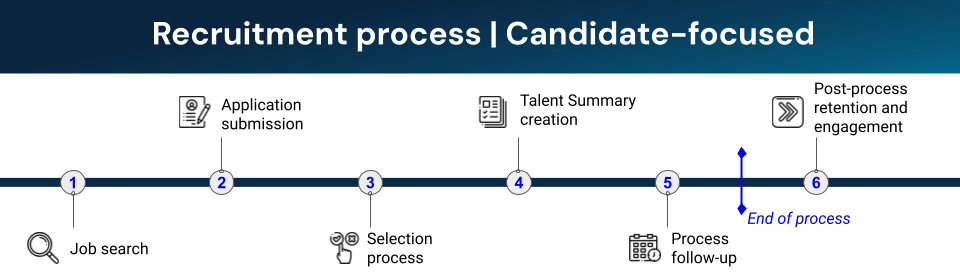
- Job search
The context:
First, the candidate begins by searching for a job among the offers published by the firm. The job search is often long and frustrating for candidates. Platforms offer many unsuitable or generic advertisements, requiring a tedious manual filtering, with the risk of missing relevant opportunities. In general cases, the candidate is the one filtering the offers proposed by companies.
The solution:
Artificial intelligence radically simplifies this search phase. Without a CV, it can analyze the candidate's session cookies to refine their searches and suggest increasingly relevant job offers to them. It automatically analyzes the CV to understand their background, skills, and preferences, then directly recommends the most relevant offers to them, even those they wouldn't have consulted spontaneously. Moreover, ads enriched by AI, more illustrated, more concrete, and better written, allow the candidate to project themselves more easily into the position, thus reinforcing their interest and confidence in the process.
Use the following connectors and APIs for data extraction: Text Parsing, Profile Parsing.
For filtering, the following APIs: Profile Searching, Job Searching, Profile Scoring, Job Scoring, and/or Grading.
For image generation: Text Imaging
- Application submission
The Context:
After identifying a job offer that matches their skills and aspirations, the candidate submits their application, including their CV and, where applicable, a cover letter. In some situations, they may also directly choose an interview slot, if that option is offered. Online application remains time-consuming: lengthy forms, repetitive fields, entry errors, and the frustration of having to enter the same information multiple times when it is already on the CV. This friction leads to a high abandonment rate and a degraded user experience.
The Solution:
AI automates the entry of the application file: using the CV, it extracts information and instantly pre-fills the fields with explicit information from the CV (e.g., first name, last name, email address, etc.). AI also automates the filling of implicit fields, deducible from the CV (e.g., seniority, field of activity, level of study). These automations limit errors and save the candidate valuable time.
Use the following connectors and APIs for data extraction: Text Parsing, Text Tagging.
- Selection process
The context:
Once their application is submitted, the candidate takes part in the different selection stages. This includes an interview with the recruiter or the end client, during which their skills, experience, and motivations are assessed. In some cases, technical tests may be requested to validate their specific aptitudes. Once their application is sent, the candidate is often faced with a lack of visibility on the next steps. Between waiting for responses, multiple exchanges with different contacts, and coordinating interviews, they can quickly lose confidence and engagement.
The solution:
AI streamlines and humanizes the selection process. It integrates with scheduling tools to automatically organize interviews according to the candidate's availability, sends them personalized reminders, and centralizes key information about their status. The candidate thus remains informed, reassured, and more involved in the process, which improves their overall feeling towards the company or the firm.
Use connectors to trigger automations.
- Talent Summary creation
The context:
If selected, a skills file is created for the end client. The compilation of this file, often through manual extraction of information (CV, test results, interview feedback), can impair the quality of the presentation and slow down the process for the candidate.
The solution:
AI automatically generates a clear, structured, and enhancing skills file. It automatically aggregates all the information collected throughout the recruitment process to create a complete and professional document. The candidate benefits from a coherent profile presentation without any intervention on their part.
Use the following connectors and APIs for data extraction: Text Parsing, File Parsing (to parse a document, e.g., results of an online test)
- Process Follow-up
The context:
At this crucial stage of the recruitment process, candidate engagement is of paramount importance. Although the candidate is primarily in a waiting posture, hoping for regular updates from the recruiter and, occasionally, requests for additional information, their active involvement is a determining factor for successful recruitment.
The solution:
This is precisely where automations come in as a strategic lever to maintain and strengthen this commitment by sending personalized messages to candidates, not only to keep them informed of the progress of their application, but also to provide them with relevant and timely information.
Use the connectors to send candidate data to personalize emails.
- Post-process retention and engagement
The context:
At the end of this process, the candidate receives feedback on their application, whether positive or negative. Once recruitment is finalized, the relationship with the candidate often abruptly stops. Unsuccessful candidates sometimes receive a standardized message, with no constructive feedback, while those who were hired only receive occasional follow-up. This lack of continuity weakens the firm's employer brand and deprives the recruiter of a talent pool that is nonetheless rich in qualified talents already engaged in the process. In the long term, this lack of loyalty harms the quality of the available candidate pool and the firm's reputation.
The solution:
AI transforms recruitment and talent management by personalizing the interaction with candidates. It ensures continuous engagement from the first contact through tailored feedback and job recommendations. Post-hire, AI facilitates employee monitoring, integration, and retention through contextualized and personalized communications. AI allows new job offers to be automatically proposed with a personalized description. In the event of a client offer, the AI automatically launches an onboarding sequence. This approach strengthens the employer brand, building the firm's trust and reputation, improving its attractiveness, and giving it a competitive advantage in the talent market.
Use the following connectors and APIs for data extraction: Text Parsing, Profile Parsing.
For filtering, the following APIs: Profile Searching, Job Searching, Profile Scoring, Job Scoring, and/or Grading.
For generating job offer recommendations: Upskilling, Job asking
Thus, AI applied to the candidate process mainly serves to save them time during information-filling stages or to propose personalized content at critical stages. Overall, AI constitutes a great lever for improving the candidate experience and increasing candidate engagement.
In conclusion, AI is emerging as a fundamental lever for optimizing recruitment, both for recruiters and candidates. For recruiters, it automates repetitive tasks, enriches decision-making, and improves the quality of applications. For candidates, it personalizes interactions, reduces delays, and offers a smoother and fairer experience. Thus, the integration of AI can also result in essential value creation thanks to augmented human capabilities and a potential for cost reduction.
AI: a must-seize opportunity for recruiting firms
AI is transforming every stage of the recruitment process for specialized agencies, impacting both recruiters and candidates. Its potential for value creation is substantial, reshaping the candidate experience while boosting the productivity of recruitment consultants. Recruitment firms now stand on the verge of a major transformation driven by the integration of artificial intelligence. Far from being a passing trend, AI is emerging as a decisive competitive advantage, enabling firms not only to optimize existing processes but also to unlock new opportunities for growth and efficiency. While early adopters benefit from a clear competitive edge, the application of AI to recruitment will eventually become universal, establishing itself as a market standard.
1. A Lever for Value Creation
The adoption of AI in recruitment is not merely about incremental efficiency gains. It acts as a powerful driver of value creation, positively impacting key performance and profitability indicators for recruitment firms. Below are the main ways AI generates measurable value for agencies:
Candidate Acquisition Cost (CAC)
The Candidate Acquisition Cost is a crucial metric for recruitment firms, as it reflects both operational excellence and financial health. Reducing CAC represents a major competitive advantage among recruitment firms.
- Enhanced candidate targeting: AI helps recruiters synthesize client needs, enabling faster and more precise targeting of relevant profiles.
- Automated CV-to-job matching: A task that traditionally took 45 minutes to 1 hour per job is now completed in under 5 minutes, significantly reducing time spent per placement.
- Reduced candidate churn: Better matching improves the candidate experience and reduces disengagement, lowering the overall time and cost per hire.
- Identification of overlooked profiles: AI rediscovers valuable candidates already in the database who might have been missed manually, maximizing internal resources and avoiding external sourcing costs.
- Faster, optimized hiring: By analyzing all profiles with equal attention and generating relevant insights, AI equips recruiters to make faster, higher-quality decisions.
- Candidate referral generation: Increased satisfaction leads to positive word-of-mouth and new candidate inflows, strengthening the firm’s reputation and pipeline.
Candidate Lifetime Value (CLTV)
The Candidate Lifetime Value reflects a firm’s ability to maximize the long-term value of its talent pool, a key measure of efficiency and attractiveness.
- Higher satisfaction and loyalty: A smoother, more relevant candidate journey leads to stronger engagement and retention.
- Selection of top profiles: AI identifies the most qualified and available candidates, delivering superior value for end clients.
- Maximized reusability and multiple placements: AI facilitates the reuse of existing profiles for different opportunities, enabling multiple placements for the same candidate and thus increasing lifetime value.
Customer Retention Rate (CRR)
The Customer Retention Rate represents a major challenge for recruitment agencies that seek to retain the maximum number of key accounts, ensuring a continuous flow of offers and ultimately the stability of managed business. It is therefore essential for them to retain their end clients.
- Improved client satisfaction and loyalty: By delivering higher-quality candidates and shortening hiring cycles, AI strengthens relationships with major clients and increases retention.Market share growth and stronger reputation: The efficiency and consistency of AI-powered services enhance brand reputation, generate positive word-of-mouth, and help capture new market share.
Beyond these potential avenues for value creation, the integration of AI into the recruitment sector produces conclusive results.
Value creation example
Fed Group is a recruitment firm, the leading specialized player in France. Supported since 2020 by HrFlow.ai, the integration of its solutions into their data sources and their Salesforce CRM has enabled automated candidate identification by AI and a much more intuitive candidate experience (drag & drop functionality, automatic reading). This client's feedback demonstrates solid value unlocked by saving 3 hours per day per recruiter through AI-powered candidate pre-selection automation. On the candidate side, Fed Group has seen a 2 million increase in applications.
2. AI: The Future Market Standard
AI usage continues to rise, both globally and within the recruitment industry. Adoption of new technologies is accelerating at an unprecedented pace. The following infographic illustrates the time (in years) it took each major technology to reach 50 million users (Sources: Statista, McKinsey, VisualCapitalist, Ericsson, Reuters).

Although these figures reflect consumer adoption, corporate usage is following closely behind. In fact, 72% of organizations were using AI in at least one business function in 2024 (up from 55% in 2023 - Global Survey: The State of AI, McKinsey). In recruitment specifically, adoption has also surged: 72% of HR and recruiting professionals are expected to use AI tools by 2025, compared to 54% in 2024 (AI adoption among HR professionals rises to 72%, Staffing Industry Analysts).
Indeed, AI has one particular advantage: its almost immediate scalability makes it particularly easy to adopt quickly, and with the right connectors compatible with major ATS, CRM, and job boards, no technical overhaul is necessary. In practice, AI multiplies the operational capacity of a firm without proportionally increasing headcount or costs. It integrates easily, adapts quickly, and deploys at scale, transforming a linear recruitment model into a truly scalable platform.
Furthermore, its modular architecture allows for progressive adoption. A firm can start with the automation of parsing or scoring, then extend the use to matching, reporting, or candidate nurturing. This "a la carte" approach reduces risks and accelerates the return on investment. This approach is possible because there is not just one AI, but AI algorithms, each trained and specialized in a specific task (generating text, photos, videos, or in our case, recruitment).
In this generalized context of the early adoption of AI, and considering the potential for value creation applied to recruitment, competitive pressure is likely to increase. Recruitment firms will have no choice but to implement AI solutions to remain competitive. This phenomenon known as institutional isomorphism means that, from a competitive advantage, AI applied to recruitment could quickly become a market standard, thus marginalizing reluctant players. The major risk for recruitment firms lies in the adoption of AI by end-clients, allowing them to reap the benefits. As demonstrated earlier, recruitment firms have assets and have always been the first to adopt technologies to maintain their competitive advantage, but they should not miss the current AI turning point...
3. How Recruitment Firms Should Adopt AI: Build vs. Buy
Recruitment firms have every incentive to adopt AI as soon as possible. While developing an in-house solution is technically feasible, it is generally suboptimal compared to rapidly deploying a specialized, proven technology such as HrFlow.ai, trained on over 1.8 billion recruitment decisions. Building an AI solution internally poses significant challenges that limit responsiveness and efficiency:
- High costs: Development and maintenance (data scientists, datasets, cloud computing resources, etc.) require substantial investment.
- Insufficient data volume: Effective AI training requires vast datasets that most firms cannot provide.
- Rapid obsolescence and slow time-to-market: In a fast-evolving sector, in-house solutions risk becoming outdated before completion, with typical long development.
- Limited regulatory and technical expertise: Compliance with regulations such as GDPR and the AI Act demands strong AI governance capabilities, typically beyond a recruitment firm’s core business. These regulations lead players to develop strong expertise to avoid any sanction.
Summary - Build vs Buy :
In conclusion, the integration of new technologies, particularly artificial intelligence, is inevitable for recruitment firms as the entire value chain is affected by AI. The prospects for value creation suggest a major impact on recruitment, but it should not be forgotten that such solutions are the result of heavy investments to achieve high-performing technology. Such a journey would therefore not be easily reproducible by a new entrant.
Conclusion
You may delay, but time will not
Benjamin Franklin
The evolution of the recruitment industry, driven by technological progress, highlights a fundamental truth: artificial intelligence is not merely a tool for optimization, it is a lever for transformation. AI is reinventing processes, addressing employers’ growing challenges, and redefining market standards. However, its successful integration requires both strategic vision and alignment with evolving regulatory frameworks.
HrFlow.ai supports recruitment firms in automating their processes and unlocking the full potential of AI, while ensuring full compliance with all applicable regulations.
Recruitment firms now stand at a crossroads: those who proactively embrace innovation will not only withstand technological disruption, but emerge as the industry’s future leaders. The firms adopting AI today are building the competitive advantage of tomorrow.